Mathway: Scan & Solve Problems
- 4.1
- Rating
- 50.00M
- Installs
- Free
- Price

 Analysis by App-foxy
I usually reach for a math-solving app at the exact moment a worksheet stops feeling manageable: a sign looks wrong, a fraction has too many layers, or I understand the lesson but cannot see the next step. That is the situation where Mathway: Scan & Solve Problems makes sense. It is a free education app from Chegg, Inc. that turns a typed, photographed, or entered problem into a guided answer experience, depending on the problem and the available solution detail.
My first impression is that it is less like a digital tutor sitting beside me and more like a fast checkpoint in my homework workflow. I can use it to identify where my calculation went off track, compare an answer with my own work, or get unstuck before returning to the textbook. The most useful habit is to treat Mathway as a verification tool, not as a replacement for understanding the method. Used that way, it saves time without encouraging me to submit an answer I cannot explain.
From a Stuck Problem to a Usable Answer
When a problem leaves me stuck, I find it helps to separate the difficulty of the maths from the friction of getting it onto a phone screen. In this section, I’ll look at how quickly that first step can happen and why checking the captured expression matters as much as reading the result. That sets up a closer look at what changes when I use the app for several problems in one study session.
You May Also Like

 AccuWeather: Weather Radar
AccuWeather Review: A Quick, Clear Forecast for Everyday Decisions
For everyday plans, the best forecast is the one you can understand quickly. AccuWeather makes rain timing, radar, and local conditions easy to act on, with a few trade-offs.

 Hill Climb Racing
Why Hill Climb Racing Still Turns Crashes Into One More Run
A tiny car, a bumpy hill and one more upgrade: Hill Climb Racing keeps resurfacing because its simple chaos makes every near-miss feel personal.

 AliExpress - Shopping App
AliExpress Makes Global Shopping Feel Personal, but Shoppers Bear the Risk
AliExpress turns a global marketplace into a pocket-sized discovery engine. Its reach is useful, its shopping loop compelling, and its trade-offs easy to miss.

 Lords Mobile: Kingdom Wars
Lords Mobile Is a Kingdom-Building Routine, Not a Quick Match
A case-by-case verdict on the building, battles, device demands, and social commitments that make Lords Mobile rewarding for some players and exhausting for others.

 PDF Scanner app - TapScanner
TapScanner Makes Paperwork Easier to Capture, Check, and Share
TapScanner makes scanning with a phone feel less like a rescue operation and more like a dependable step in getting work done. Its capture tools are useful, though not flawless.

 Block Blast!
 Shows How Much a Puzzle Game Can Leave Out
A quiet grid game shows why puzzle players increasingly value instant clarity, repeatable skill and low-pressure play—and where the genre still needs to catch up.
More From Our News Desk
View All News


Starting with the problem in front of me
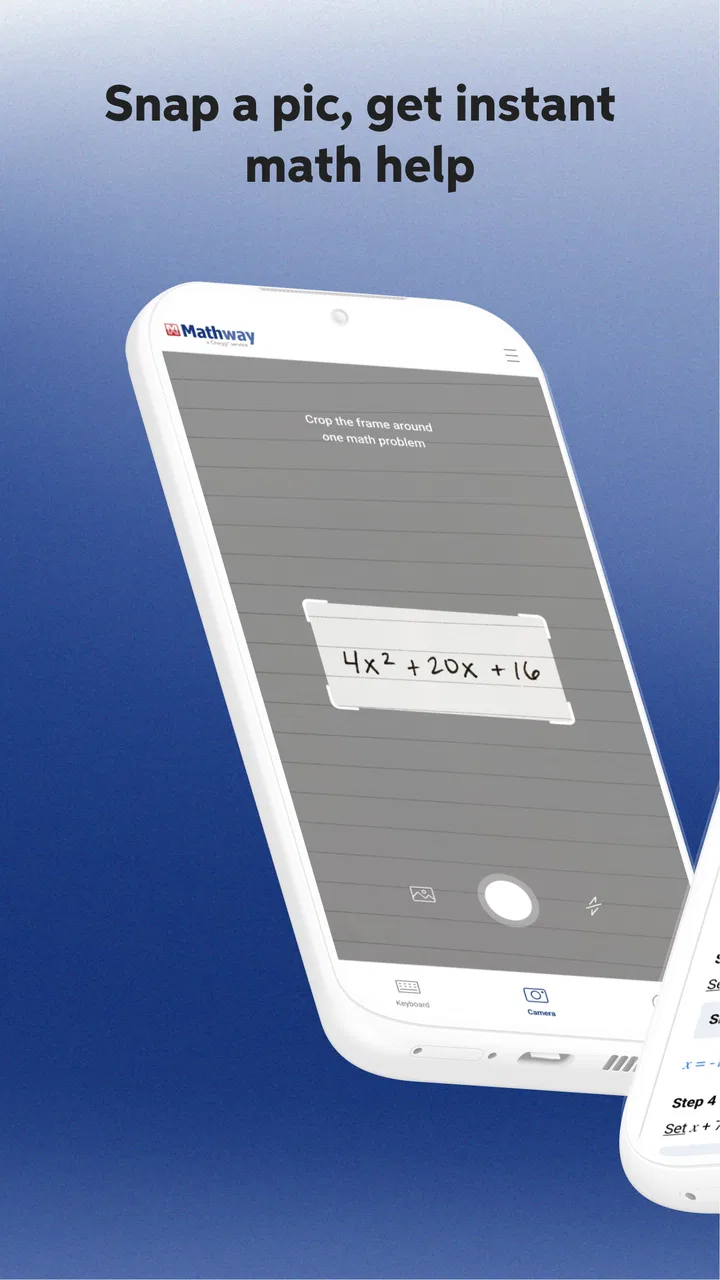
The app is built around a simple starting condition: I have a math problem and need help interpreting or solving it. I can enter the expression manually, which is often the safest choice for a short equation, or use the camera-based workflow when the problem is printed on a page. The scan option is especially convenient when I am working through several exercises and do not want to retype every symbol.
That convenience comes with an important trade-off. A camera can capture a page quickly, but math notation is less forgiving than ordinary text. A faint minus sign, a small exponent, a fraction bar, or a decimal point can change the entire result. I therefore check the recognized expression before trusting the answer. This small pause is one of the best practical tips for using the app: the scan is an input shortcut, not proof that the original problem was read perfectly.
For handwritten work, I am even more cautious. Neat writing helps, but crowded lines and unusual symbols can still create confusion. When the expression matters, I prefer typing the part that looks uncertain rather than repeatedly scanning it. That mixed workflow—scan the page, then correct the equation manually—usually gives me speed without surrendering control.
Choosing the right mathematical path
Once the problem is visible in the input area, Mathway needs to identify what kind of mathematics it is dealing with. The app covers more than basic arithmetic, so the same tool can be useful for an elementary calculation, an algebra exercise, a graph-related question, or a more advanced problem. I still read the expression carefully because the category chosen by the app affects how the result is presented.
This is where Mathway differs from searching the web for a similar example. A web search may return an explanation for a problem that looks close but uses different values or assumptions. Here, I can work from the exact expression in front of me. That makes it better for checking a particular homework line, while a textbook or a well-written lesson remains better for learning why a general method works.
A useful routine is to solve the problem myself first, even if my attempt is incomplete. I then enter the original question and compare the result with my work. If the answers disagree, I inspect the copied expression before assuming that my algebra is wrong. This catches a surprisingly common source of wasted time: the app may be solving a slightly different problem because one parenthesis or exponent was entered incorrectly.
Reading the result instead of stopping at it
The immediate outcome is an answer, but the value of that answer depends on what I do next. For a quick arithmetic check, the result may be all I need. For algebra, calculus, or another multi-stage exercise, I look for the working and use it as a map back to my own attempt. The important question is not simply “What number did it give me?” but “At which transformation did my work stop matching?”
This is one of the app’s strongest everyday uses. I can take a photo of a worksheet problem, inspect the recognized equation, review the result, and then rewrite the method in my notebook. That handoff turns a private screen answer into something I can actually use in class. If I only copy the final line, I have solved the immediate deadline problem but learned very little.
Some users will want a complete explanation for every exercise. That is where expectations need to be realistic. Mathway is excellent at reducing the time between question and answer, but it does not automatically replace a patient teacher who can adapt an explanation to my exact misunderstanding. For a student who needs foundational instruction, I would pair it with class notes, a textbook, or a dedicated learning resource rather than relying on it alone.
The handoff from phone to notebook
My preferred workflow has four stages. First, I attempt the problem without help. Second, I scan or type it and verify the input. Third, I compare the displayed work with my own steps. Finally, I write a short explanation in my own words. The last stage matters because it exposes whether I truly understand the operation or have merely recognized a familiar-looking answer.
This also makes Mathway useful for parents and tutors. Instead of giving a student an answer immediately, I can ask them to show their attempt, use the app to locate the disagreement, and then discuss the specific step. The app becomes a neutral checking point rather than the person doing all the thinking. That is a more productive handoff than sending a screenshot of the final result.
For group study, I would use it to settle a disputed calculation, then return to the shared method. It is quick enough for that role, but the group should still agree on notation and reasoning. A correct result can come from an incorrectly copied problem, and an apparently different form can sometimes represent the same mathematical value. The screen is helpful evidence, not the whole discussion.
Where the workflow saves the most time
The app is particularly practical when the bottleneck is transcription. Entering a long expression by hand can take longer than solving a short exercise, especially on a phone keyboard. Scanning reduces that friction and lets me move quickly through a stack of printed questions. It is also useful late at night when I am checking whether a small calculation error is responsible for a larger failed answer.
Another strong use is targeted revision. Rather than asking Mathway to complete an entire worksheet, I select a few representative problems: one with fractions, one involving parentheses, and one that uses the technique I find difficult. I compare the paths and then attempt similar questions independently. This gives me more learning value than checking every answer mechanically.
The free price makes that initial workflow easy to try, while in-app purchases range from $0.99 to $149.99 per item. I would pay attention to which explanation or assistance features are available within the version I am using before building my study routine around them. The free entry point is attractive for occasional checking, but frequent users should decide whether the extra help is worth the cost for their own course level and habits.
Where the flow breaks
The first failure point is recognition. A scan can be fast and still be wrong, particularly with handwritten notation or a page containing several nearby expressions. I never skip the input review. If the answer seems absurdly easy, unexpectedly complicated, or unrelated to my attempt, I go back to the captured equation before blaming the mathematics.
The second failure point is context. A standalone expression does not always carry the full instructions from a lesson. A teacher may ask for a specific form, a particular method, a domain restriction, or an interpretation of a graph. Mathway can help with the calculation, but I still need to read the assignment and format the response as requested. An answer can be mathematically valid and still fail to meet the exercise’s purpose.
The third failure point is overreliance. If I use the app before thinking, I lose the chance to practice recognizing patterns. This is especially risky when preparing for a test, because a phone-assisted solution does not prove that I can reproduce the method under exam conditions. I get better results when I delay the app until I have made a genuine attempt or identified the exact step that blocks me.
There is also a practical difference between needing a result and needing a lesson. Someone who wants a rapid check on homework will probably appreciate the direct workflow. Someone who repeatedly asks why a rule works may find the experience too answer-centered unless they deliberately supplement it with notes and examples. In that situation, a structured course or a teacher-led explanation is the better primary tool, with Mathway serving as backup.
How it compares with ordinary alternatives
Compared with a calculator, Mathway is more useful when the problem involves symbolic manipulation rather than one final numerical operation. A calculator is usually faster for simple arithmetic and gives me fewer distractions. Mathway becomes more valuable when I need to inspect an equation, compare stages, or work through a longer expression.
Compared with manual textbook solutions, the app is faster and more convenient for a specific problem, especially when scanning saves typing. A textbook is usually stronger for building a complete concept because it can explain vocabulary, show several variations, and connect the exercise to a lesson. I would not replace a good textbook with Mathway; I would use the app when I need a second check while studying from the book.
Compared with a general web search, Mathway keeps the workflow centered on my own expression. That reduces the risk of copying a solution to a merely similar question. Search is still better when I need a broad explanation, a visual lesson, or several different approaches to the same topic. The choice depends on whether my immediate problem is computation or comprehension.
Who will get the most from it
I think it is a strong fit for students who already know the basic rules but occasionally get stuck in the mechanics. It is also useful for adult learners returning to mathematics, parents checking a child’s homework, and anyone who wants to verify a handwritten calculation before moving on. The camera workflow is particularly helpful for printed assignments, provided the captured expression is reviewed carefully.
I would be more cautious recommending it as the main study method for a beginner who cannot yet identify the type of problem being solved. In that case, the app may produce a result without supplying enough conceptual support. It is also not the right choice for someone who wants to avoid screen-based assistance altogether or who needs a teacher to respond to personalized questions.
The app is available for Everyone, which suits its broad educational purpose, and it runs on Android devices using version 8.0 or later. Its current version is 6.12.0, so I would check device compatibility before installing it on an older phone. With an average rating of 4.1 from around 414 thousand ratings, and over 50 million installs, it is clearly a familiar choice for many learners, though popularity does not remove the need to check each result.
My final workflow recommendation
After using Mathway in the role it handles best, I see it as a fast bridge between confusion and a next step. I start with my own attempt, scan or enter the expression, inspect the transcription, study the result, and then recreate the reasoning away from the phone. That sequence preserves the app’s speed while keeping the learning responsibility with me.
My recommendation is simple: use Mathway to locate mistakes, confirm calculations, and move past a narrow blockage—not to outsource an entire course. If you need a quick answer for a specific problem, it is convenient and approachable. If you need patient instruction, repeated practice, or feedback tailored to your misunderstanding, combine it with a teacher, textbook, or structured learning resource.
That balance is what makes Mathway: Scan & Solve Problems worth keeping on my phone. It is free to start, broad enough for many school-level situations, and especially efficient when typing is the real obstacle. Its weak point is not that it gives answers; it is that an answer can feel like learning when I have not examined the path. Used thoughtfully, it shortens the distance from a stuck worksheet to a clear, checkable solution.
FAQs for Mathway: Scan & Solve Problems
01What is Mathway: Scan & Solve Problems used for?
Mathway is an educational problem-solving app designed to help users work through mathematics questions. It supports topics ranging from basic arithmetic and algebra to geometry, trigonometry, calculus, statistics, and some chemistry problems. You can enter a question by typing it, taking a photo, or using the calculator interface. It is useful for checking homework, reviewing methods, and understanding where an answer comes from.
02How does the scan feature work in Mathway?
The scan feature lets you photograph a printed or handwritten math problem with your phone’s camera. After capturing the image, Mathway attempts to recognize the symbols, numbers, and operators before solving the question. Results can depend on image quality, lighting, handwriting, and formatting, so it is worth checking the recognized equation before accepting the answer. Clear, well-positioned photos generally produce the most reliable results.
03Is Mathway free to use, or does it require a subscription?
Mathway offers a free version with access to basic problem solving and final answers, but some advanced features may require a paid subscription. In particular, detailed step-by-step explanations and certain premium tools are commonly placed behind the subscription plan. Pricing and available features can vary by platform, region, and current app policies, so review the purchase screen carefully before starting a trial or confirming a recurring subscription.
04Does Mathway show the steps for solving a problem?
Mathway can provide step-by-step explanations for many supported problems, which makes it more useful for learning than an answer-only calculator. However, detailed working is generally associated with its premium features, and the amount of explanation may vary depending on the subject and equation. The app should be used as a study aid: compare its method with your class notes and make sure you understand each transformation rather than copying the final result.
05Can Mathway solve every type of math problem accurately?
Mathway covers a broad selection of mathematical subjects, but no automated solver handles every question perfectly. Complicated notation, unclear handwriting, unusual textbook formats, word problems, or problems requiring a specific teacher-approved method may produce incomplete or incorrect results. Always inspect the input and check the answer logically. For important assignments, use Mathway to verify your work and support learning, not as a replacement for instruction or independent practice.
Pros
- Covers arithmetic
- algebra
- calculus
- statistics
- and several other subjects.
- Step-by-step solutions can make difficult problems easier to understand.
- Camera scanner quickly recognizes many printed math exercises.
- Includes useful graphs and visual explanations for selected problems.
- Available on both Android and iOS with a simple
- student-friendly interface.
Cons
- Some detailed solution steps require a paid subscription.
- Handwritten or poorly lit problems may be recognized incorrectly.
- Explanations can feel brief for students seeking full lessons.
- Advanced topics may produce answers without enough supporting context.
- Frequent use of the scanner may encourage solving without practicing independently.

Mathway: Scan & Solve Problems
Gallery